Batch reactor
A first-order reaction HybridModel: CMA-ES for the trunk, then AdamW for the residual. A second script compares it with the classical alternative, one Arrhenius fit per pH, on runs neither model trained on. Read this for staged training with fit(freeze=...), or for a worked case of when a residual network earns its place. The RL example continues from the fitted model.
Run it
uv run python examples/batch_reactor/train_hybrid.py
uv run python examples/batch_reactor/compare_baselines.py
train_hybrid.py takes about 20 s and writes seven figures to examples/batch_reactor/figures/. compare_baselines.py runs 54 fits in about two minutes and writes three more. Both accept --no-plot, and --generations / --steps for a short run. train_hybrid.py --save-predictors PATH writes the fitted predictors for the RL example.
The model
The trunk is Arrhenius centred at 25 °C, with two bounded scalars:
The residual is a 16-neuron MLP inside a BoundedPredictor whose output box is _model.py.
The hidden truth is Arrhenius with simulate_fn turns them into ramp_profile inside the vector field. Only _data.py.
Code
Both phases call fit on the same model:
model = hm.HybridModel(
    predictors=build_predictors(key=k_init),
    simulate_fn=simulate_fn,
    state_to_output=state_to_output,
    output_channel_names=OUTPUT_CHANNELS,
    solver=SOLVER,
Phase 1 passes freeze=hm.BoundedPredictor, which holds the residual fixed and leaves the trunk's two scalars, and fits them with CMA-ES (32 candidates, 60 generations by default):
config_p1 = hm.EvosaxTrainingConfig(
    algorithm="CMA_ES",
    population_size=args.population_size,
    steps=args.generations,
    init="lhs_box",
    init_box_extent=args.init_box_extent,
    sigma_init=args.sigma_init,
)
# The default mask already holds BoundScaler leaves fixed. Freezing every
# BoundedPredictor on top leaves the trunk's two latent scalars.
fit_p1 = model.fit(train_dataset, config_p1, key=k_p1, freeze=hm.BoundedPredictor)
model_p1 = fit_p1.model
Phase 2 freezes the trunk's class instead and refines the residual with AdamW (800 steps by default):
config_p2 = hm.OptaxTrainingConfig(steps=args.steps, lr=args.lr)
fit_p2 = model_p1.fit(train_dataset, config_p2, key=k_p2, freeze=ArrheniusKinetics)
The script asserts that phase 1 trains exactly two scalars and that the frozen half is bit-identical after each phase.
compare_baselines.py builds the classical baseline from the same predictor tuple. simulate_trunk_fn integrates the trunk alone and ignores the residual, so the same freeze choices work on both models:
predictors = build_predictors(key=k_init)
hybrid, baseline = (
    hm.HybridModel(
        predictors=predictors,
        simulate_fn=simulate,
        state_to_output=state_to_output,
        output_channel_names=OUTPUT_CHANNELS,
        solver=SOLVER,
    )
    for simulate in (simulate_fn, simulate_trunk_fn)
)
Results
Two-phase fit
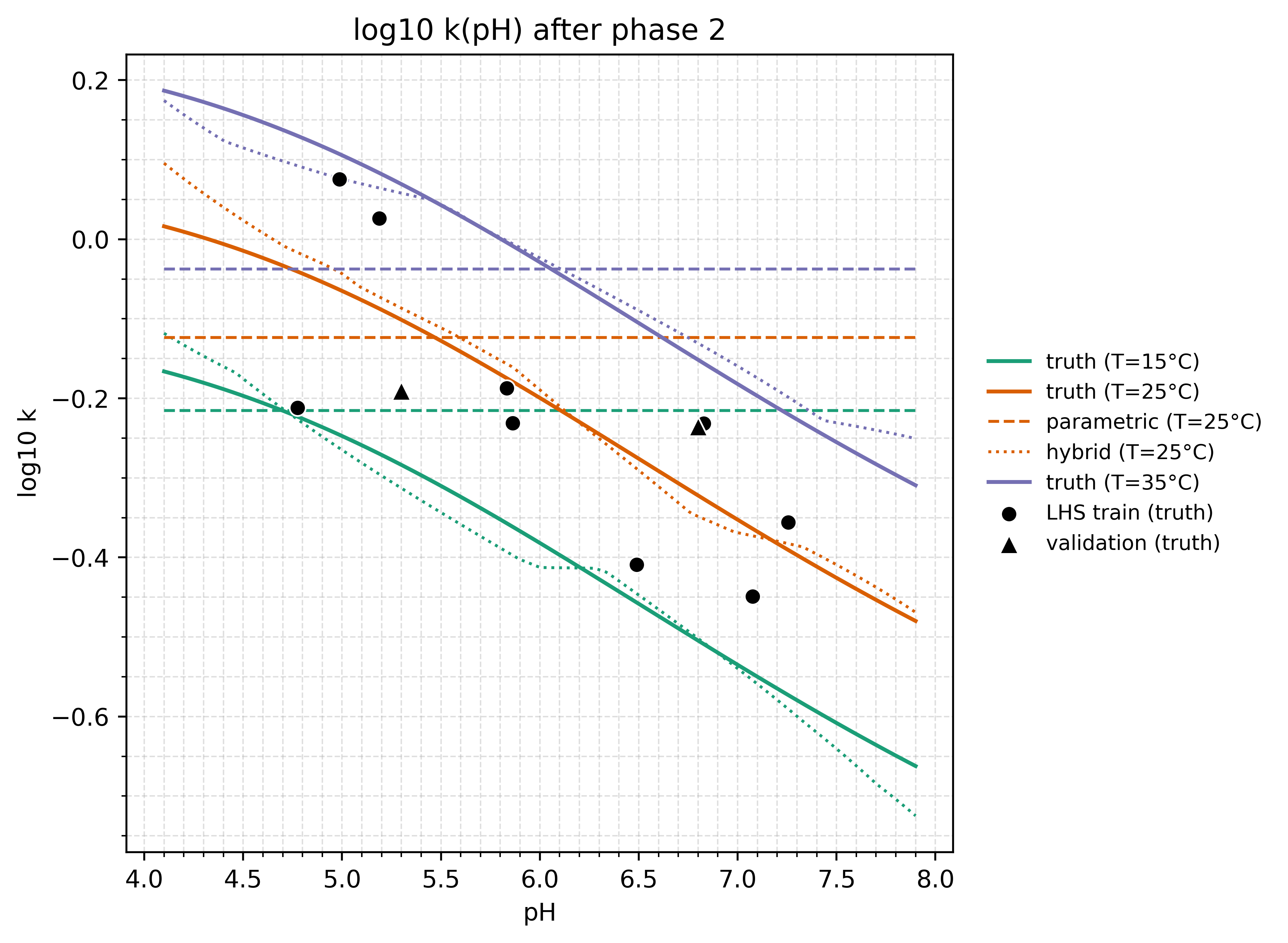
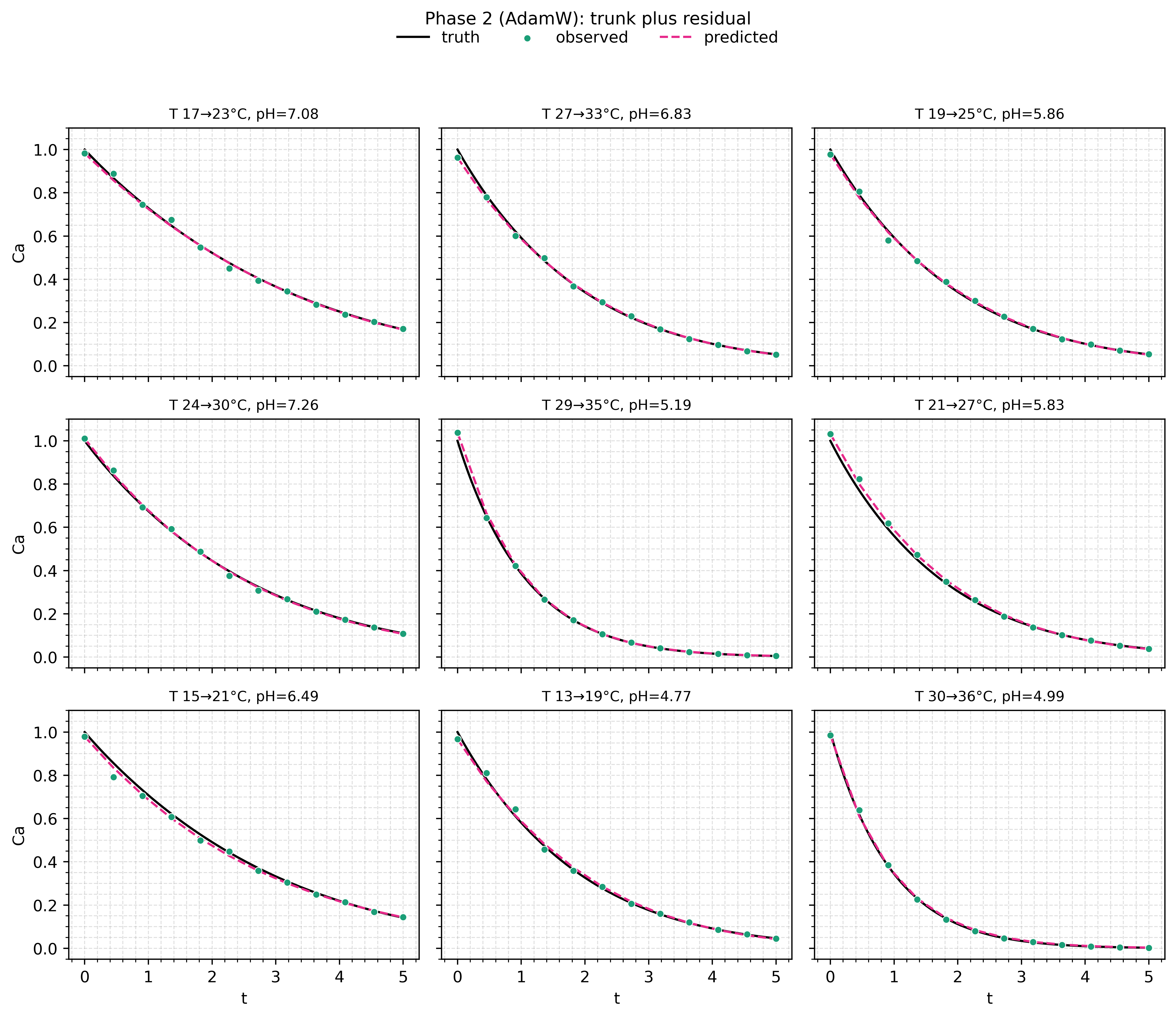
Nine training runs on a Latin hypercube in
| model | train | validation |
|---|---|---|
| trunk only, after CMA-ES | 0.959 | 0.962 |
| hybrid, after AdamW | 0.9985 | 0.9973 |
The pH-blind trunk settles on
Against per-pH Arrhenius fits
compare_baselines.py uses a different design, chosen so the classical method can be fitted at all: four ramp runs at each of pH 5.0, 5.85 and 7.0. Fitted bin by bin, Arrhenius recovers
| model | test | |
|---|---|---|
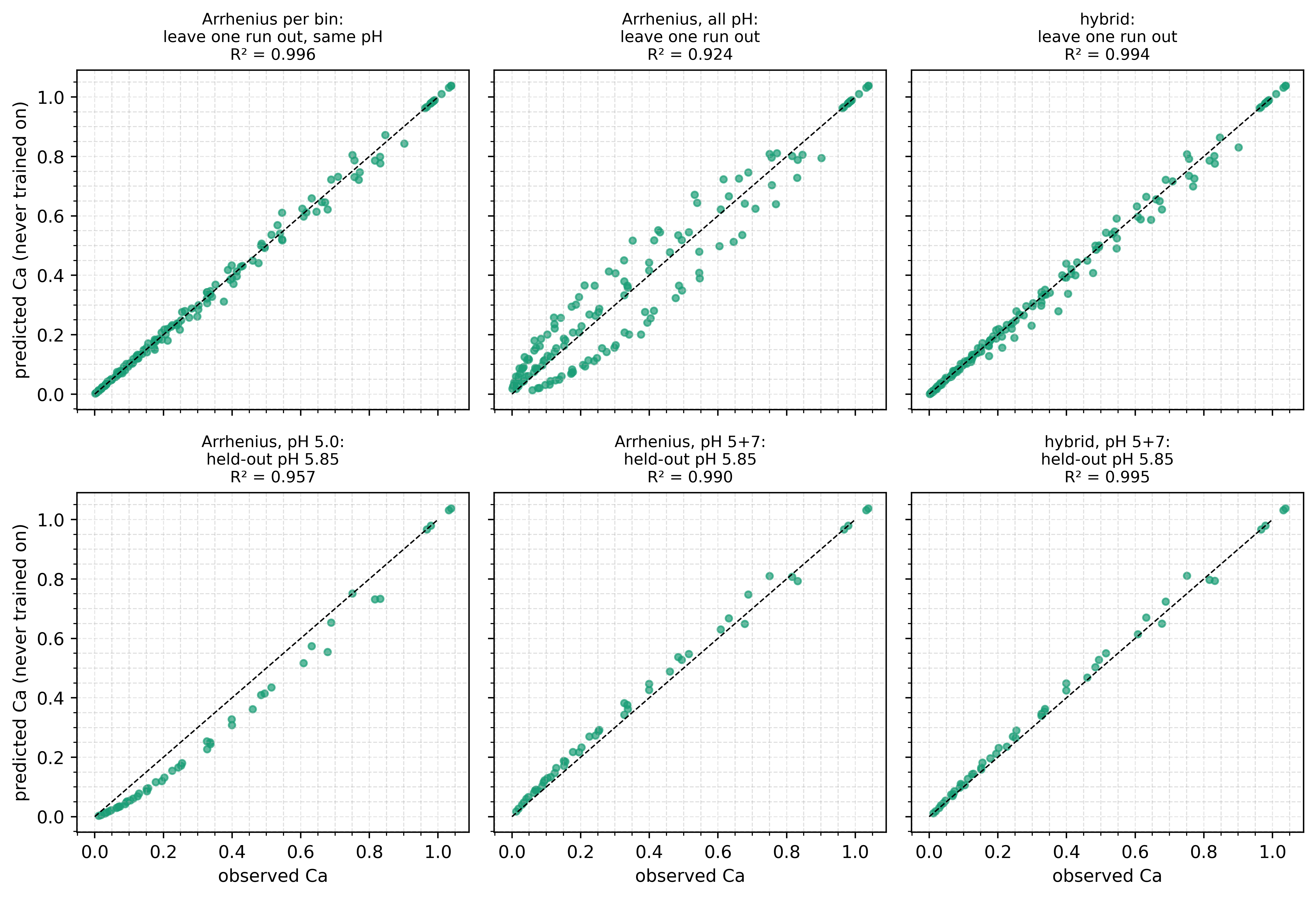
| Arrhenius, one fit per pH | leave one run out, same pH | 0.996 |
| Arrhenius, one fit across all pH | leave one run out | 0.924 |
| hybrid | leave one run out | 0.994 |
| Arrhenius, pH 5.0 fit | held-out pH 5.85 | 0.957 |
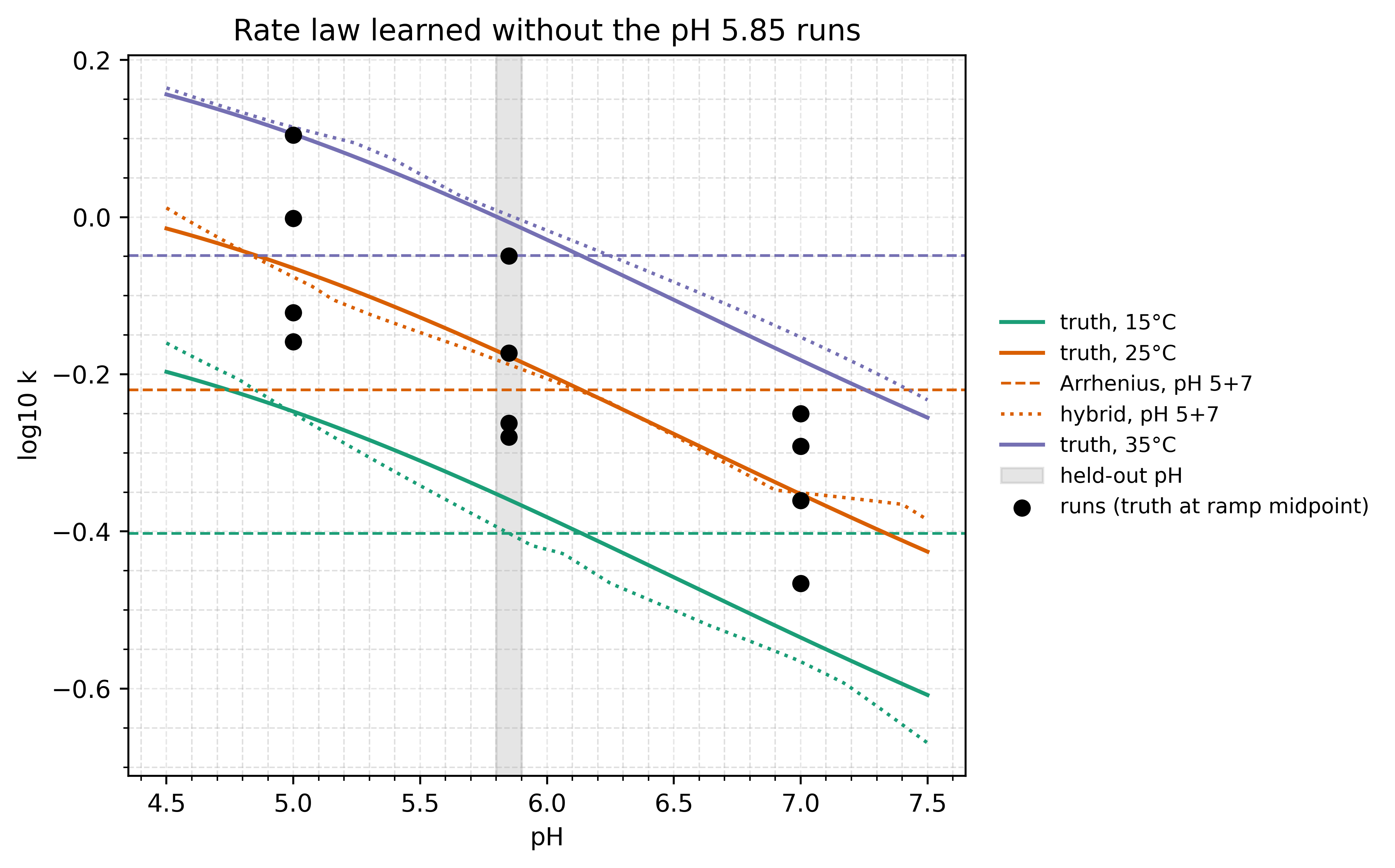
| Arrhenius, one fit on pH 5.0 and 7.0 | held-out pH 5.85 | 0.990 |
| hybrid, trained on pH 5.0 and 7.0 | held-out pH 5.85 | 0.995 |
Per-pH fits are as good as the hybrid inside their own bin and give no model for any other pH. A single Arrhenius fit across all pH loses the most, because one prefactor has to stand in for a rate that changes by a factor of two across the bins. The hybrid matches the per-bin fits with one model.
On the held-out pH the margin is smaller. Borrowing the nearest bin's fit is clearly worse. A joint Arrhenius fit on the two outer bins lands close, because pH 5.85 sits near the midpoint of their rates and averaging the two happens to be about right there. The hybrid is still the best of the three, and the rate law it learned without pH 5.85 bridges the gap:
Things to try
--doe-seedontrain_hybrid.pydraws a different design. Watch the trunk'smove with how correlated and pH happen to be. --generations 5 --steps 20on either script for a quick check.- Move
HELD_OUT_BINincompare_baselines.pyto an edge bin. Neither model was built to extrapolate in pH.