SBML hybrid kinetics
A published, curated SBML model — Fujita et al., Sci. Signal. 2010, the EGF/ERK cascade (9 species, 11 reactions) — loaded from an actual .xml file and plugged into a jaxhybridmodels fit, with one of its rate parameters supplied by a neural BoundedPredictor.
The file is parsed with a small hand-rolled converter (sbml_loader.py): python-libsbml gives the MathML AST for every kinetic law, sympy converts it into an expression, and sympy.lambdify(..., "jax") turns each reaction's rate law into a callable JAX function. The converter is ~300 lines, example-local, and reads the SBML's own structure: species, global and local parameters, stoichiometry, initial assignments, and state-dependent assignment rules (which the example uses as its measurement model — the paper's scaled "total" readouts pEGFR_tot, pAkt_tot, pS6_tot).
The hybrid twist is the crystallisation pattern applied to a systems biology model: the SBML supplies the known structure (stoichiometry and published kinetics), and an MLP learns the one unknown rate law — how the EGF-EGFR association constant depends on the EGF dose. Reaction v1 is reversible mass-action,
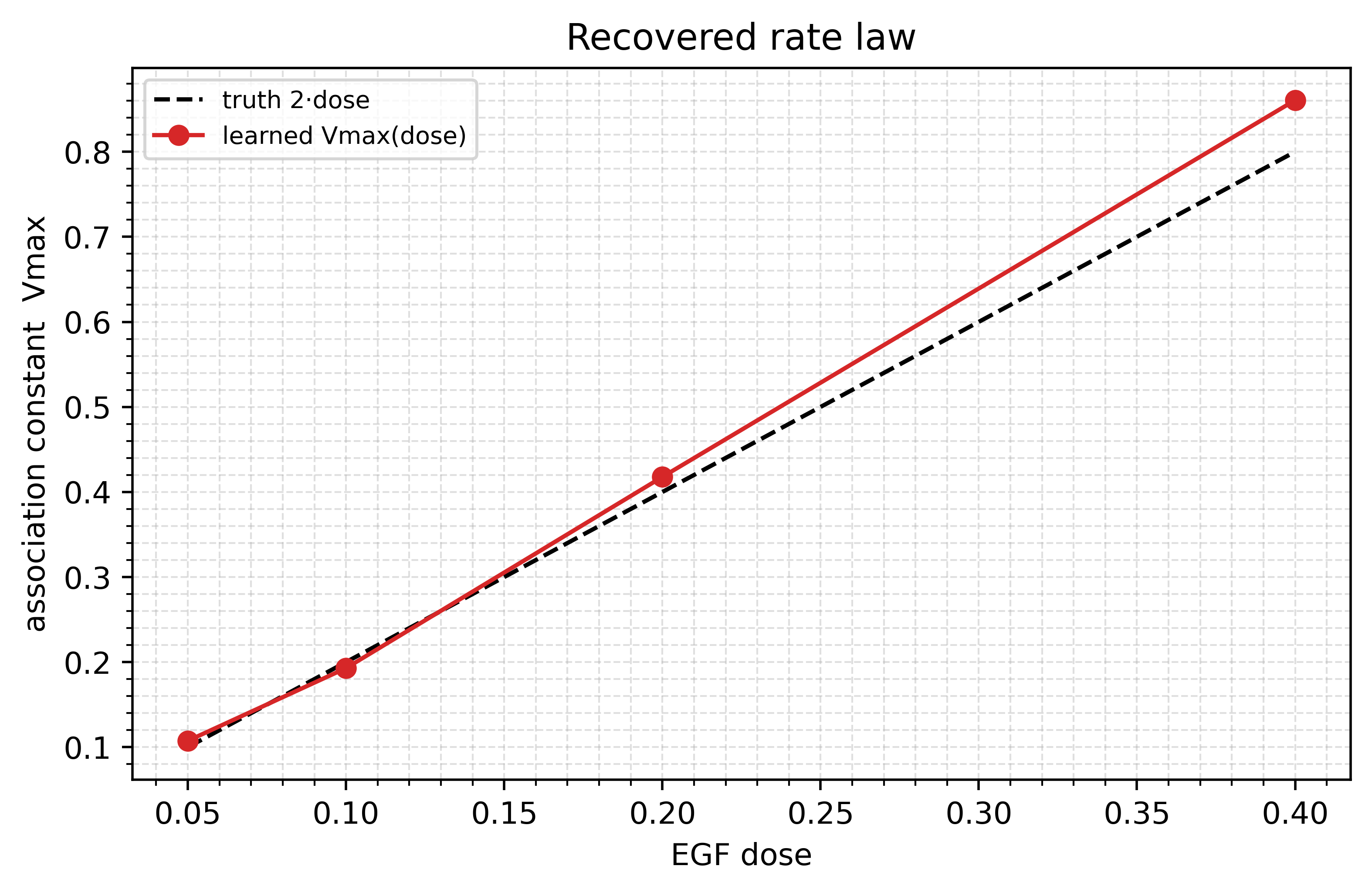
v1 = Cell * (EGF * EGFR * k1 - EGF_EGFR * k2)so the example declares the forward constant k1 unknown and lets the network supply it as Vmax(dose) (the reverse constant k2 stays from the file). The truth is Vmax(dose) = 2 * dose. Data is simulated from the SBML at four EGF doses with noisy readouts; the fit must recover the rate law from the dose-response time series alone.
Two numerical lessons are documented in the example's docstring:
- Keep the reverse term. An irreversible uptake law drives EGFR to exactly zero, and the solver grinds on the resulting kink (some parameter values take >50k steps and fail). The reversible law has a well-defined equilibrium everywhere.
- Kvaerno3, not Kvaerno5. Kvaerno5's Newton solve diverges at specific parameter values (sharp threshold behaviour); Kvaerno3 integrates the whole parameter space in under ~100 steps.
uv run python examples/sbml_hybrid/train_sbml_hybrid.pyDependencies (python-libsbml, sympy) are in the examples extra:
uv sync --extra examplesResults
Default settings, seed 0, 120 steps. The three scaled readouts fit to the noise floor (R^2 >= 0.86, 0.99 on the two fast channels), and the association law comes out close to the truth Vmax(dose) = 2 * dose — recovered from the dose-response time series alone, with the SBML structure supplying everything else.
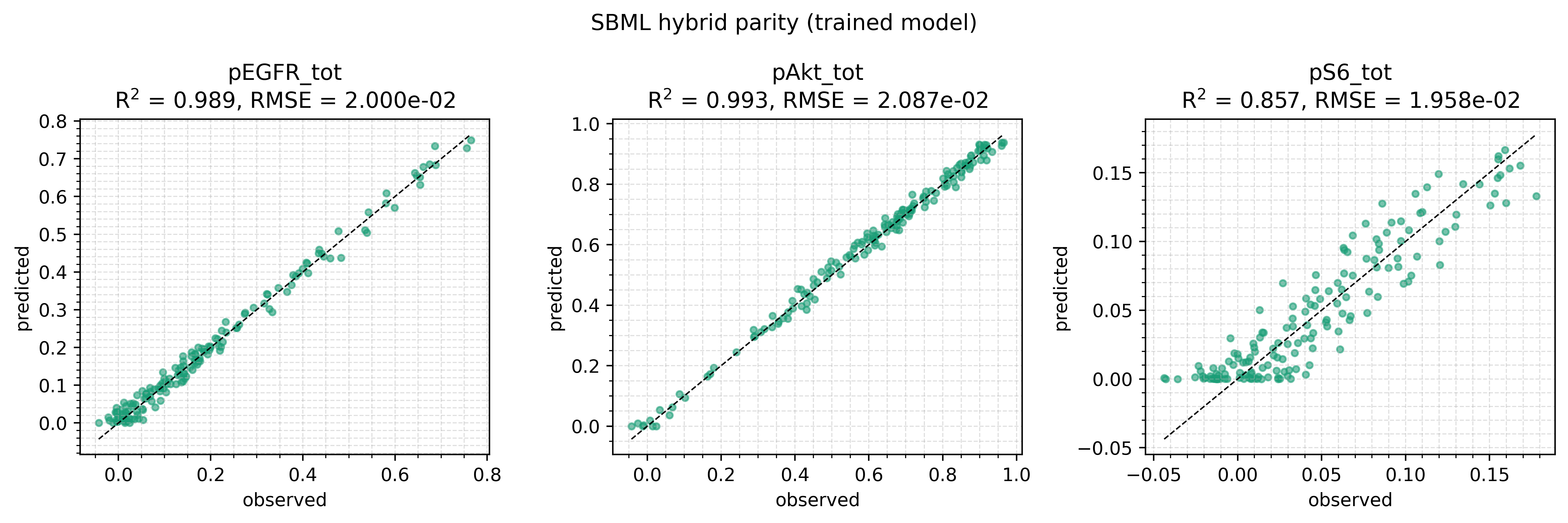
pS6_tot trails the other two channels: it peaks only after t = 250, so its terminal ramp is under-sampled at T_MAX = 300.